Dual Cure Lamps Explained — What Every Nail Tech and Student Needs to Know
This article builds on our Proper Cure post — if you haven't read that one yet, start there first. Understanding what a proper cure actually is will make everything in this article land with a lot more context.
Your lamp is the single most important tool controlling your cure quality. In this article we are going deeper: how a dual cure lamp actually works, what the numbers on the spec sheet mean, how to identify a wavelength mismatch before it causes problems, and how to choose the right lamp for how you work.
How a dual cure lamp actually works
Dual cure gels contain two sets of photoinitiators built into the formula. One set reacts to UV wavelengths — specifically 365 nanometres. The other set reacts to LED wavelengths — for Planet Nails products, that is 405 nanometres.
A quality dual cure lamp emits both of those wavelengths simultaneously. The moment your client's hand is placed under the lamp, both sets of photoinitiators are activated at the same time — driving polymerisation from both directions at once. You are not choosing one pathway or the other. Both are firing together.
It is not just about having the right wavelengths — it is about having both working together at the right intensity, for the right amount of time. That combination is what drives a reliable proper cure with a dual cure product.
What the numbers on the spec sheet actually mean
When you look at a lamp spec sheet, you will sometimes see measurements in μW/cm² — microwatts per centimetre squared. This is the irradiance: essentially the intensity of light energy the lamp delivers to the surface of the nail. Higher irradiance means more light energy hitting the gel per second, which means faster and more thorough activation of the photoinitiators.
Here is how the two Planet Nails full cure lamps compare:
| Lamp | Mode | 365nm | 405nm | Total |
|---|---|---|---|---|
| PN Cordless | Standard | 8,500 μW/cm² | 5,000 μW/cm² | 13,500 μW/cm² |
| PN Cordless | High Power | 10,200 μW/cm² | 6,100 μW/cm² | 16,300 μW/cm² |
| PN Mach III | Standard | 11,500 μW/cm² | 5,600 μW/cm² | 17,100 μW/cm² |
| PN Mach III | Health | 10,800 μW/cm² | 4,900 μW/cm² | 15,700 μW/cm² |
Both lamps are more than capable of achieving a proper cure with PN products. The differences come down to how and where you are working — which we will cover shortly.
Wavelength mismatch — the silent cure killer
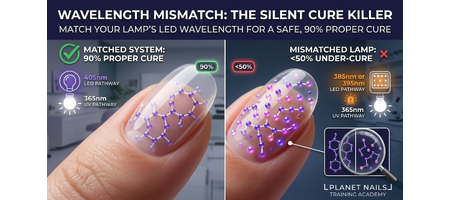
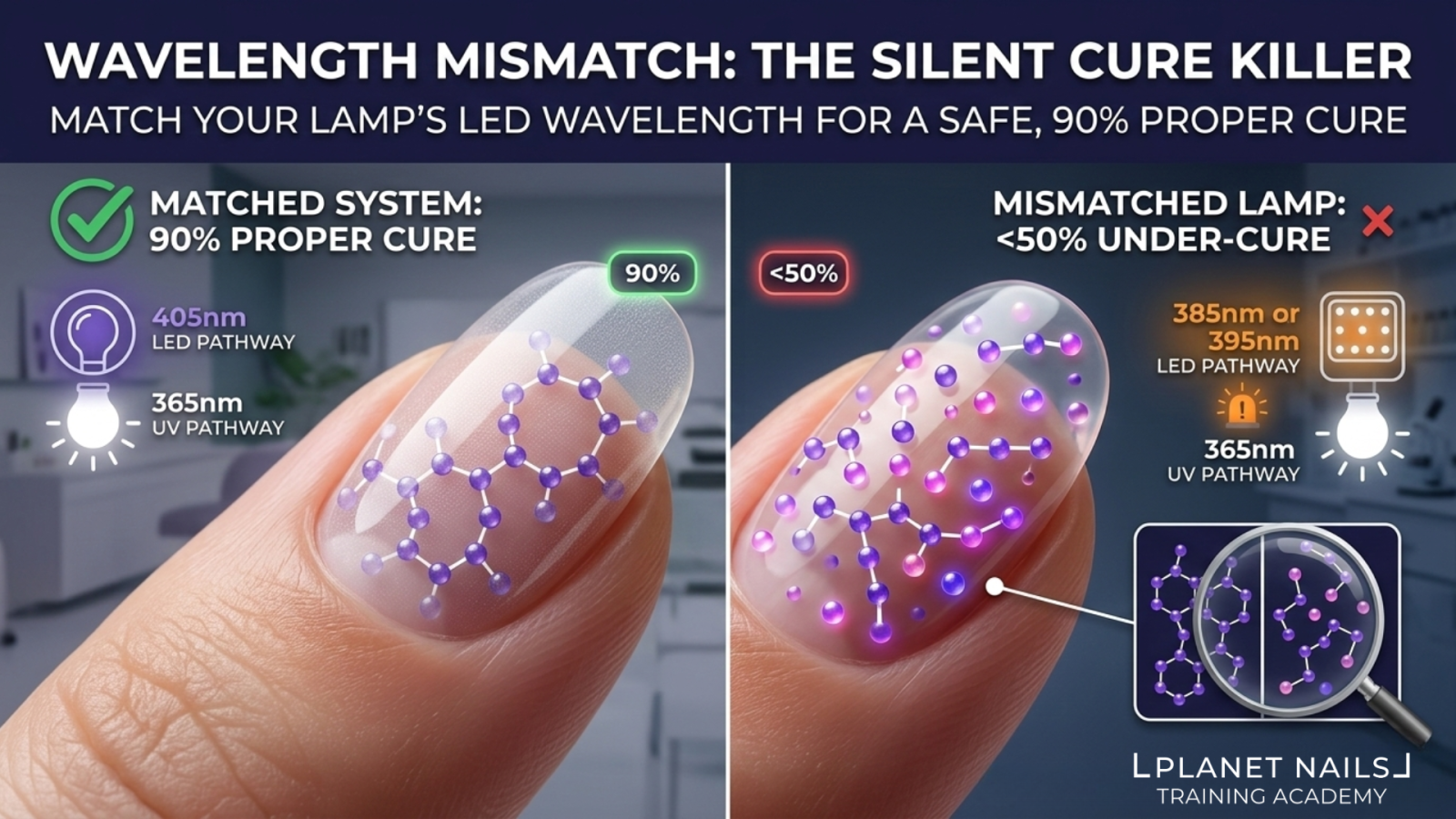
If you are using a lamp whose wavelengths do not match your product's photoinitiators, you will not achieve a proper cure. And because 50% cure looks, sounds, and feels exactly like a proper cure, you will not know it is happening.
Here is the specific scenario to watch for. Most generic dual cure lamps on the market emit 365nm as their UV component — that part is usually fine. But the LED component varies. Some lamps emit 385nm, some 395nm, some 405nm. There is no industry standard for LED wavelengths.
Planet Nails gels require 405nm for the LED pathway. If your lamp's LED output is 385nm or 395nm, those photoinitiators will not be fully activated. The UV initiators will fire — giving you approximately 50% cure that looks perfect — but the LED pathway is incomplete. The result is an undercured set with no visible indication.
Always confirm that your lamp's wavelength output matches the requirements of the product you are using. When in doubt, check the manufacturer's specifications. This applies to every product, not just Planet Nails.
Why dual cure lamps can produce more intense heat spikes
Because a dual cure lamp fires both wavelengths simultaneously, both sets of photoinitiators are activated at the same time. Polymerisation happens faster and more vigorously than it would under a single-wavelength lamp — and because polymerisation is an exothermic reaction, more reactions happening at once means more heat generated at once.
Dual cure lamps can therefore produce more intense heat spikes than standalone LED or UV lamps, particularly with thicker product layers like builder gels where there is more material reacting simultaneously. This is precisely why low heat mode exists on both PN lamps — it is not a comfort feature, it is a direct response to the increased thermal output of simultaneous dual-wavelength activation.
Do not wait for a heat spike to fully develop. Remove the hand from the lamp immediately at the first sign of heat. Place the fingers flat on top of the lamp and press down — the pressure helps relieve the heat and pain sensation. With PN lamps, the infrared sensor switches the light off the moment the hand is removed, so there is no ongoing curing or continued spiking. With lamps that do not have this sensor, keeping the nail near any part of the lamp can still continue both curing and spiking — pressing flat on top of the lamp keeps the nail away from the light entirely. Once the heat has passed, the client can return their hand to the lamp. With PN lamps, the full selected cure time will restart automatically, ensuring the complete cure time is always delivered.
For any builder gel application, use low heat mode as your default. The gradual power ramp over 90 seconds significantly reduces peak heat without compromising cure quality.
Corded vs cordless — which is right for you
Cordless lamps are genuinely useful. If you do both nails and pedicures, or if you work mobile, the flexibility a cordless lamp provides is real and valuable. Not being tethered to a power outlet changes how you work.
However, for techs who are seated at the same desk for every client, every day — a corded lamp is the stronger recommendation, and the reason comes down to curing reliability.
Mobile techs. Salons and studios offering both nail and pedicure services. Anyone who needs to move between workstations or locations.
Desk-based techs with a fixed workstation. Mains power delivers consistent output every single service, every single time.
A cordless lamp draws from a battery, and battery performance is variable — it degrades over charge cycles and is affected by temperature. Critically, once the battery drops below 15%, proper cure cannot be guaranteed. The lamp may still turn on and the light may still look bright, but the irradiance has dropped below the threshold needed for a reliable polymerisation reaction.
If the battery reaches 15% capacity, stop using the lamp for curing services and recharge before continuing. Curing below this level risks undercure with no visible indication.
PN lamp modes — what each one is actually for
Both PN lamps have multiple operating modes. Using the wrong mode for the wrong product is a genuine source of cure problems — here is what each mode is designed to do.
Default for the vast majority of services. If your product requires 405nm, follow the LED cure time (60–90 sec). If you have a wavelength mismatch and are relying on the UV pathway, follow the UV cure time (2–4 min).
For builder gels and heat-sensitive clients. Power ramps gradually over the full 90 seconds rather than hitting full intensity immediately — reducing the peak exothermic heat. Use this as your default for all builder applications.
Drops intensity to 75% across all timer settings for a gentler first-pass flash cure. Must always be followed by a full 90 sec low heat cure or a full 60 sec standard cure. This is a heat management tool — not a standalone cure setting.
For highly pigmented gel polishes only — one-coat blacks, whites, nudes, art gels. Not recommended for builder gels. The increased intensity can cause significant heat spikes in thicker product layers.
The Mach III's red light therapy feature
The Mach III emits a third wavelength: 660 nanometres. Red light at 660nm does not cure gel — it delivers red light therapy to the skin of the hands, supporting reduced inflammation, improved circulation, and skin regeneration.
The Mach III operates in three light modes:
The pink mode in particular is a genuine client experience differentiator — every cure step throughout the service doubles as a skin treatment, with no additional time required.
The bottom line
A dual cure lamp works by emitting both UV and LED wavelengths simultaneously, activating both sets of photoinitiators in the gel at once — provided a matched system is being used. The wavelengths must match your product, the irradiance must be sufficient, and the cure time must be followed. All three, every time.
For Planet Nails products, both the PN Speciality Dual Cure Cordless and the PN Mach III are built to deliver exactly that. The right choice between them comes down to how you work — and understanding the strengths of each will help you make a decision that supports consistent, reliable cure quality across every service.
Want to go deeper on gel chemistry, lamp technology, and client safety? Explore our full range of courses at the Planet Nails Training Academy.
Explore PNTA Courses