Rubber Base 101 — Nail Education for Professional Technicians | PNTA

Author: Planet Nails Training Academy

31 March 2026

Everything nail technicians need to know about rubber bases — what they do, how they bond, and how to choose between Lastik, Lastik HF and Stick 'n Float for every client.

What rubber bases are, how they work, and how to choose the right one for every client in your chair.

What is a rubber base?

A rubber base is a flexible, adhesive base layer applied directly to the nail plate before colour or builder product. The term "rubber" refers to the nature of the cured product — soft, cushioning, and flexible rather than hard and rigid. It moves with the nail instead of fighting against it.

That flexibility is what sets rubber bases apart from standard base coats, and it's the reason they've become such an important part of professional nail systems. But to understand why they work the way they do, it helps to look at what's happening at the nail plate itself.

How does a rubber base actually bond?

The nail plate is made up of overlapping layers of keratin — think of them like roof tiles sitting on top of each other. When a nail is untouched, those scales sit flat and smooth, making it harder for product to grip. When we dehydrate the nail and remove the shine, those scales open slightly, creating more surface area for the product to bond to.

The rubber base flows into those micro-irregularities and cures in place — this is a mechanical bond. For clients with oily or dense nail plates, the scales resist penetration, which is why thorough prep and targeted adhesion products make such a measurable difference. The flexibility of the cured rubber base then maintains that bond through the normal flex and stress of daily wear.

What does a rubber base actually do?

A rubber base isn't just a step you move through to get to the colour. It's doing several important jobs simultaneously — and understanding those jobs is what allows you to choose the right product and apply it correctly for every client.

1

Heat spike buffer

Gel products generate heat during curing. The rubber base sits between the nail plate and the product above it, absorbing and dispersing that heat before it reaches the client.

2

Retention for problem lifters

Because it moves with the nail, a rubber base maintains its bond under daily stress — particularly valuable for clients who experience lifting with standard bases.

3

Bridging layer for flexible nails

A rigid product over a flexible nail will eventually lift. The rubber base absorbs flex — movement transfers into the rubber layer rather than breaking the bond with the nail plate.

4

Soak-off base under file-off systems

Applied under hard gels, a rubber base lets you file back to the rubber layer and soak off the remainder — protecting the nail plate from aggressive filing all the way down.

5

Colour change without full removal

De-bulk back to the clear rubber base layer and follow an infill protocol — saving time, reducing product removal, and minimising stress on the nail plate.

The three Planet Nails rubber bases

PN stocks more than one rubber base deliberately. Different clients respond differently to formulations at a biological level — the goal is always to match the product to the client's needs, not to find a single universal solution.
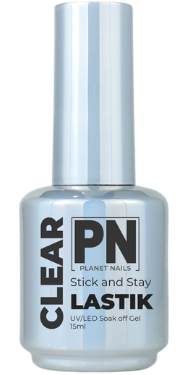
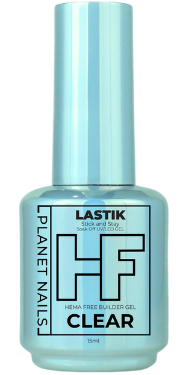
Lastik HF BIAB

HEMA-free flexible hybrid
HEMA-free TPO-free Base + builder Steps 3 & 4
  • Same flexible hybrid format as Lastik
  • HEMA-free — uses a phosphate adhesion monomer instead
  • For confirmed HEMA allergy or persistent lifting with Lastik
  • Can also be used as a builder

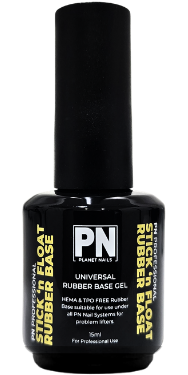
Stick 'n Float

HEMA-free rubber base only
HEMA-free TPO-free Base only Step 3
  • Rubber base only — cannot be used as a builder
  • HEMA-free and TPO-free
  • Self-leveling, medium viscosity
  • Excellent for oily, sweaty, flaky, or brittle nail plates
  • Up to 3 weeks wear under gel polish

Matching the right base to each client

The right base for one client isn't always the right base for another. Here's how to think through that decision.

Client situation Recommended starting point
Most new clients Sticky Bond primer + Lastik
Confirmed HEMA allergy HEMA-free primer + Lastik HF or Stick 'n Float
Lifting persists despite correct prep Escalate to Lastik HF or Stick 'n Float
Oily, sweaty, or difficult nail plate Stick 'n Float — consider scrub coat protocol
Client needs builder capacity Lastik or Lastik HF (Stick 'n Float cannot build)
Important: Some clients genuinely need HEMA for optimal adhesion. Switching to HEMA-free as a blanket precaution is not the answer — HEMA-free is a clinical response to a confirmed need. For many clients, HEMA is precisely what resolves their retention issues.

The prep sequence

Preparation is where retention is won or lost. This sequence applies regardless of which rubber base you're using. HEMA-free systems in particular require especially intentional prep — the adhesion chemistry works differently and alternative ingredients affect how the product bonds to the nail plate.

  1. 1
    Both tech and client wash hands with soap and water — removes physical debris and pathogens before you begin
  2. 2
    Sanitise both tech and client hands at the nail table
  3. 3
    Gently push back the skin folds
  4. 4
    For clients with excess moisture — oily or sweaty nail plates — additional dehydration at this stage using The One, acetone, or talc/baby powder as needed
  5. 5
    Remove true cuticle using cuticle prep bits — dead, non-living tissue only. Never cut living skin.
  6. 6
    Remove shine from the nail plate using a fine sanding band or nail buffer — looking for a light, even surface. Not rough, not over-worked.
  7. 7
    Sanitise using The One, which also performs a dehydration step. After this you are looking for a shine-free, dead skin-free, chalky appearance. If the nail looks rough or over-worked, you've gone too far.
  8. 8
    Step 1 — Prep: Apply nail prep to the nail plate
  9. 9
    Step 2 — Prime/Bond: Apply Sticky Bond or primer based on your client's needs. Allow to air dry.
  10. 10
    Step 3 — Base: Apply your chosen rubber base. Cure for 60 seconds under the PN Speciality Dual Cure lamp, 60 seconds under a 405nm lamp, or 2 minutes under a 365nm lamp.
  11. 11
    Proceed with your system

Applying your rubber base

Fresh application

  1. Complete the full prep sequence
  2. Apply a smooth, even coat across the entire nail
  3. Ensure clean product margins — sidewalls, cuticle area, free edge
  4. Layer thick enough to cushion but not so thick the nail looks bulky
  5. Cure for 60 sec (PN lamp / 405nm) or 2 min (365nm)
  6. Proceed with your colour or builder system

Infill and rebalance

  1. De-bulk the existing product
  2. Complete prep and prime
  3. Apply a continuous coat — focus thickness in the regrowth area
  4. Draw a thinner layer over existing product for a flush transition
  5. Ensure clean product margins before curing
  6. Cure for 60 sec (PN lamp / 405nm) or 2 min (365nm)
  7. Proceed with your system
The scrub coat protocol
The scrub coat maximises adhesion for clients prone to lifting. It can be used with any of the three PN rubber bases. Most first appointments won't require it — introduce it when a client returns with lifting, or communicates a history of retention issues at their first visit.
Step 1 — Scrub
Apply a small amount of rubber base to the nail plate. Using a gel brush — the shorter, stiffer bristles and reduced product load allow for deliberate application without flooding the skin folds — scrub the product into the nail plate using firm circular motion. This saturates the keratin scales and maximises mechanical adhesion.
Step 2 — Layer
Without curing, apply a continuous layer of rubber base over the top using the brush from the bottle — the softer bristles and greater product load make it easier to achieve a smooth, consistent cushioning layer. Do not skip this step. Cure only after both steps are complete.
Why two different brushes? The gel brush gives you control during the scrub — less product, stiffer bristles, precise application. The bottle brush gives you coverage for the layer — softer, more product, smooth and even. Each tool is doing a different job.

Removal

Standard soak-off removal

Applies to Lastik, Lastik HF, and Stick 'n Float
  1. Buff or file the surface to break the seal
  2. Soak in acetone for 10–15 minutes
  3. Gently remove softened product with an orangewood stick
  4. Do not force — re-soak if needed

Under file-off systems

When used under hard gels (PUG, Iconic)
  1. File back to the rubber base layer — do not file through it
  2. Soak off the rubber layer with acetone
  3. Protects the nail plate from aggressive filing all the way to the natural nail

Prep thoroughly. Choose intentionally. Apply correctly.

A rubber base is one of the most functional products in your kit. Understanding what it does, why the chemistry matters, and how to match it to each client is what separates a service that consistently performs from one that doesn't.


Leave a comment

Comments have to be approved before showing up

Read Also

Rubber Base 101

Everything nail technicians need to know about rubber bases — what they do, how they bond, and how to choose between Lastik, Lastik HF and Stick 'n Float for every client.

31 March 2026

Dual Cure Lamps Explained

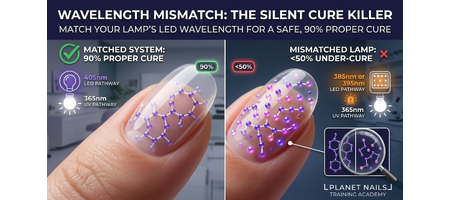
How dual cure nail lamps work, what wavelength mismatch does to your cure, and how to choose the right lamp for your salon or studio.

18 March 2026

Why "Fully Cured" is a MYTH!!!

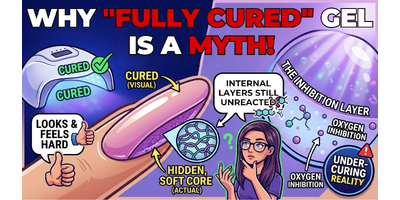
Learn why "fully cured" isn't achievable in gel nails, what proper cure means, and how undercured gel causes client sensitisation.

17 March 2026