Why "Fully Cured" Is a Myth — And What Proper Cure Actually Means
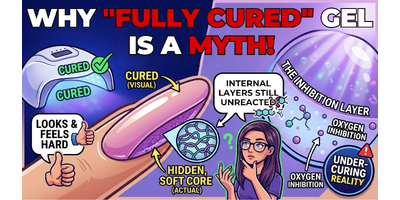
If you have been using the term "fully cured" in your salon, this article is going to reframe how you think about every gel service you do. There is no such state as fully cured when it comes to gel nails. The goal has always been something different — and understanding that distinction is one of the most important things you can know as a nail professional.
.png)
What "properly cured" actually means
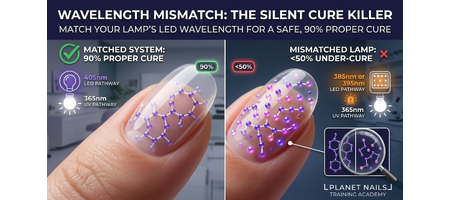
When you cure a gel product under a lamp, you are triggering a chemical reaction called polymerisation — where individual molecules link together to form a solid, connected network. That reaction, even under perfect conditions, never reaches 100%. With the right lamp, the right wavelengths, and the correct cure time, the best you will ever achieve is around 90%.
That 90% is what we call a Proper Cure. It is the target. Not 100% — because 100% is not chemically possible. At 90% polymerisation, enough molecules have linked together to lock any remaining unreacted molecules within the cured structure, preventing them from leaching out during wear. That is what makes a properly cured gel safe.
At just 50% polymerisation, a gel already looks cured, sounds cured when you tap it, and feels cured to the touch. There is no obvious sign that anything is wrong. This is where the majority of gel allergy problems in our industry originate.
A technician does a beautiful set, is confident the cure is complete, and the client leaves happy. But over the following weeks, those undercured molecules begin to leach out of the product during daily wear — through contact with water, heat, and friction. Then the client returns for their infill. When the technician files into that undercured product, or soaks it off, there is another hit of exposure. This cycle repeats, service after service, until the immune system reaches its threshold.
What undercured molecules actually do
Uncured molecules do not stay inert inside the product. Over time they leach out and come into direct contact with the skin around the nail. Repeated exposure to acrylate compounds is one of the key drivers of sensitisation — where the immune system begins to recognise those compounds as a threat and mounts a response.
Once a person is sensitised, it is permanent. There is no reversal. This is why proper cure is not simply a matter of service quality or durability — it is a direct client safety issue.
The two factors that most affect cure
1. Your lamp and cure time
This is where most cure failures occur — and it is more complex than many technicians realise.
Dual-cure gels contain two sets of photoinitiators: one that reacts to UV wavelengths, and one that reacts to LED wavelengths. Both sit in the formula simultaneously. Whichever light source you use, the corresponding initiators drive the polymerisation reaction — provided you follow the recommended cure time for that source.
For Planet Nails gels specifically:
| Light source | Wavelength | Cure time for proper cure |
|---|---|---|
| UV lamp | 365nm | 2 to 4 minutes |
| LED lamp | 405nm | 60 to 90 seconds |
If you are using a quality LED lamp that emits 405nm and follow the recommended 60 to 90 second cure time, a proper cure is achievable.
Most dual-cure lamps emit 365nm as their UV component. If your lamp's LED wavelength does not match the product's LED photoinitiators — for PN gels, that is 405nm — the UV initiators will react to the 365nm output when you follow LED cure times. The result is approximately 50% cure. The gel looks, sounds, and feels cured. But it is not.
There is no industry standard for LED wavelengths the way there is for UV. While 365nm is the established UV standard, LED products across the industry use photoinitiators calibrated to anywhere from 380nm to 405nm. It is essential to confirm that your lamp's output matches the product you are using. When in doubt, refer to the manufacturer's specifications.
Lamp degradation is another factor that is easy to overlook. Output decreases over time even when the lamp still turns on and appears to function normally. LED lamps cannot have their bulbs replaced — when output degrades, the whole lamp needs to be replaced. As a general guide, plan to replace your lamp every 12 to 24 months.
2. Layer thickness
Light can only penetrate so far through a product layer. If the layer is too thick, the lower portion will not receive sufficient light energy to reach a proper cure — regardless of cure time. This is particularly important with builder gels and any structural application. Thin, even layers will always cure more reliably than thick ones.
The inhibition layer — and why the wipe step matters
Every time you cure a gel layer, the surface comes out tacky (with most gels). This is called the inhibition layer, and it is not a product fault or a sign of inadequate cure. It is a predictable result of the chemistry: oxygen in the air interferes with polymerisation at the surface, leaving a thin layer of unreacted, sticky gel on top of your cured product.
That inhibition layer serves a purpose during the service. It is the adhesion surface that your next product layer bonds to. Wiping between structural layers removes that surface and compromises adhesion.
Do not wipe. The tacky inhibition layer is your adhesion surface for the next layer.
Always wipe — even no-wipe formulas. The inhibition layer contains unreacted molecules that must be removed from the finished surface.
Even products marketed as no-wipe top coats have only reached a 90% cure and will have unreacted molecules on the surface. The "no-wipe" designation refers to the finish — not the presence of unreacted surface molecules. Seeing as your top coat is your final layer, wiping is in order to remove any unreacted molecules on the surface. Always wipe the final layer.
After service order — and why it matters
Cuticle oil contains penetration enhancers — ingredients that allow the oil to absorb effectively into the skin. If there is any uncured product or filing dust remaining on the hands when cuticle oil is applied, those same penetration enhancers will drive monomer molecules directly into the skin. This is a meaningful and avoidable exposure risk.
The bottom line
Proper cure is not about achieving perfection — it is about reaching the 90% polymerisation threshold through the right combination of lamp, wavelength, cure time, and layer thickness. Anything less, and you have undercured molecules that will leach out over time, accumulate as exposure events, and eventually drive sensitisation.
Understanding the chemistry behind cure — not just the rule, but the reason — is what allows you to make better decisions at the desk, identify risk before it becomes a problem, and build a salon or studio that genuinely protects your clients.
We cover all of this in depth inside the Planet Nails Training Academy. If you want to go further on lamp technology, sensitisation, or product chemistry, explore our courses below.
Explore PNTA Courses